Last year, we surveyed business leaders across Europe and found they face a notable contradiction: While most (97%) recognise that knowledge management is critical to their business, very few (28%) have a coherent strategy to execute it well. This gap—knowing knowledge management matters but struggling to deliver on it—is what I call the knowledge paradox. And it’s not just frustrating; it’s expensive.
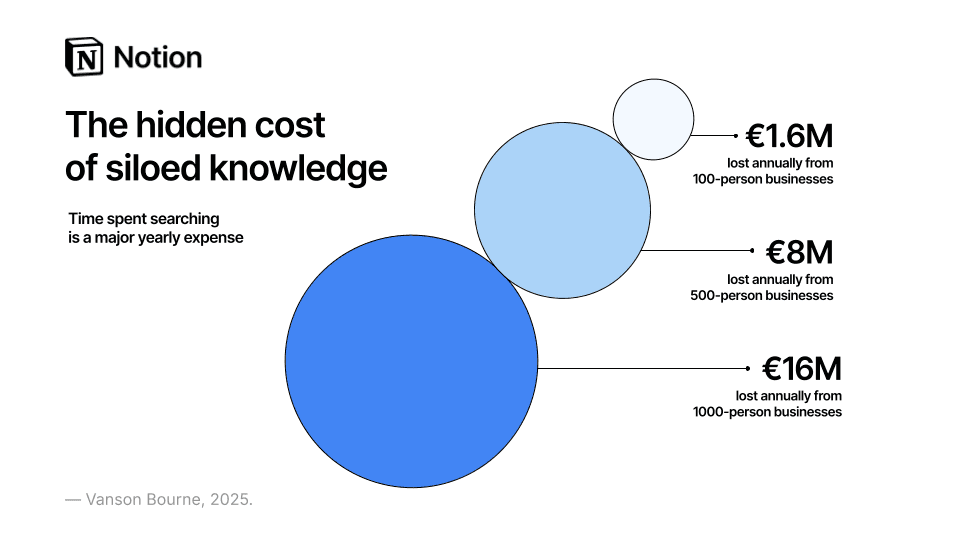
Poor knowledge management costs European companies up to €16,000 per employee annually in lost productivity. For a 500-person company, that's €8 million a year spent searching for information that already exists, recreating work that's been done before, and watching institutional knowledge vanish when people leave.
Annual productivity losses for German organizations from time spent searching for information.
Annual productivity losses for German organisations from time spent searching for information.
To understand how European companies are addressing this knowledge paradox, we spoke with leaders across France, Germany, and the UK. From scaling startups to enduring enterprises, what we heard was consistent: Centralised knowledge is the foundation that makes everything else possible—increased productivity, less repetitive work, faster decision-making—and ultimately, the ability to leverage AI effectively.
Here's what they've learned about knowledge management, what they're doing about it, and why getting it right is the defining advantage that separates thriving companies from the rest.
<aside>
Read the Research: Strategic Knowledge Management in the Age of AI
We asked 650 European decision-makers how they’re rethinking knowledge management in the age of AI. Dive into the research to discover how leading teams are cutting software sprawl, improving search, and unlocking productivity without increasing complexity.
</aside>
The knowledge paradox manifests differently depending on your stage of growth, but the outcome is the same: when information is spread across people and tools, progress slows.
For hypergrowth companies, speed is the advantage. As teams scale, the informal knowledge-sharing that works for 10 people breaks at 100. Decisions move from hallway conversations to fragmented threads. Context gets lost, silos form by default, and that competitive speed evaporates. In today’s fast-moving markets, speed can determine survival.
For established enterprises, friction often comes from legacy systems and entrenched ways of working—making shifts to new platforms and approaches increasingly costly and complex. “It's very hard to change once the foundations are not ideal,” observes Snir Yarom, CTO of Taxfix. “If these foundations are not built from the get-go, the cost to change later becomes very high."
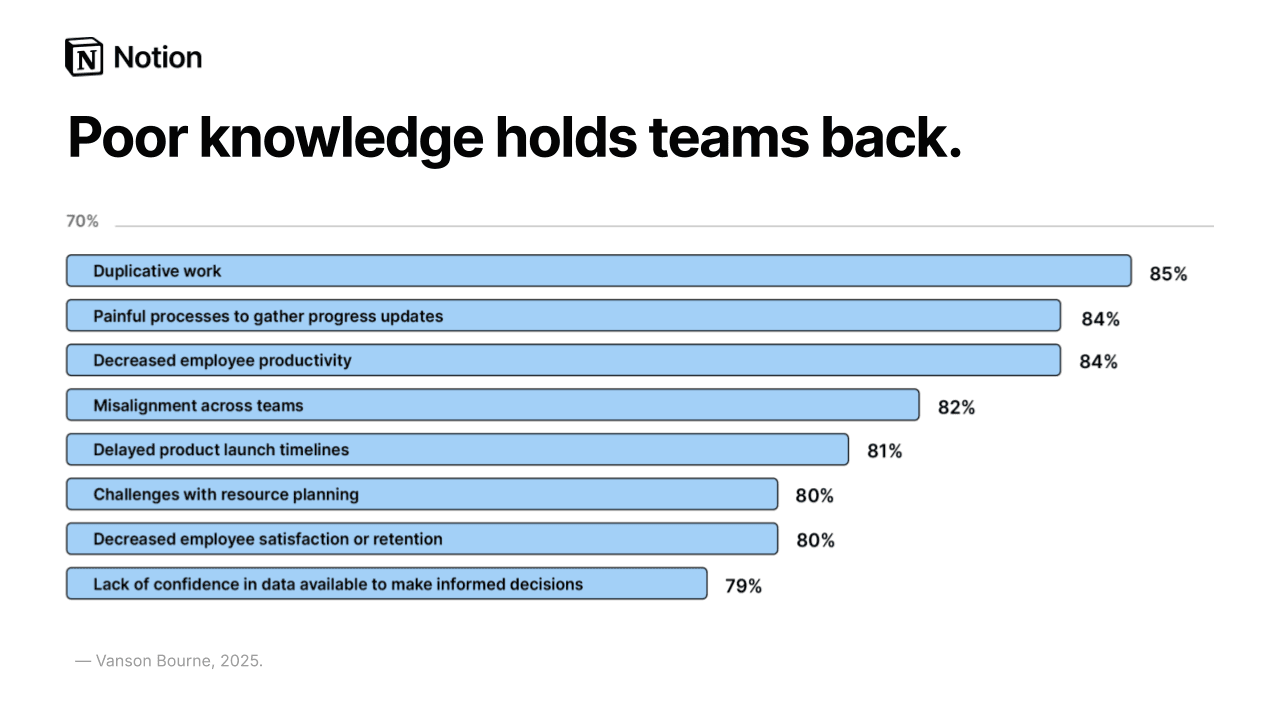
The true cost of poor knowledge management extends beyond lost productivity—it erodes confidence in decision-making and slows execution. Our research found that most engineering, product, and design leaders (79%) in Europe lack confidence in the data they use to make informed decisions because the information they need is scattered across too many tools. Dan Bathurst, CPO at Nscale, has seen this dynamic in practice: “An absence of centralised knowledge can cause a lot of confusion, which then reduces confidence in someone wanting to make a decision. If employees don't have all the information, they may not feel empowered to sign off on something.”
When information is siloed or lost, the impact ripples across the organization.
When information is siloed or lost, the impact ripples across the organisation.
Luckily, AI is rapidly reshaping how businesses across Europe access and use company knowledge. In 2025, our research found that 56% are already using AI for knowledge management, and another 29% were piloting it. But, there’s a catch: AI can only build upon what already exists. Companies deploying AI without solid knowledge foundations are learning this the hard way. At Nelly, early attempts to build a patient-facing bot exposed gaps in their documentation, forcing the team to reconstruct knowledge retroactively. As Alexandre Imbeaux from Lucca puts it, centralised knowledge "is not an advantage, it's survival."
The takeaway is clear: Before AI can answer questions, write drafts, or support customer-facing workflows, companies need to get their knowledge house in order.
Understanding the problem is one thing, but fixing it is another. Once you've recognised AI needs a strong knowledge foundation, the question becomes: How do you build a documentation culture that sticks?
Across the leaders we spoke with, a few patterns emerged: